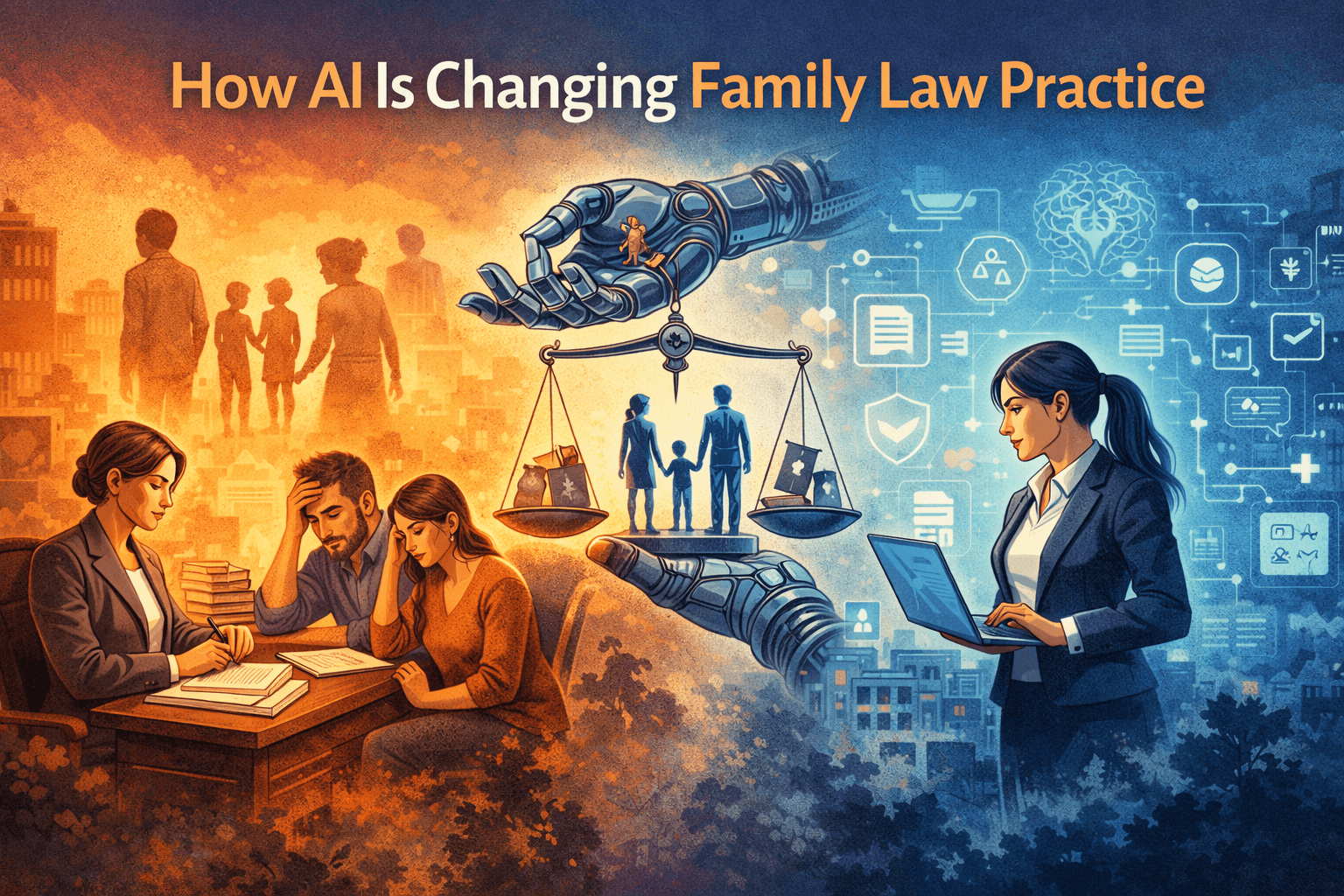
How AI Is Changing Family Law Practice
Artificial intelligence is no longer a future concept in the legal industry. It is already reshaping how family law firms operate, often in ways that are not immediately visible.
Ask most attorneys how AI is used in family law, and the answers tend to focus on familiar categories: document automation, faster research or client-facing tools. While accurate, those descriptions capture only a small part of what is changing.
The more meaningful shift is not about doing the same work faster. It is about changing how legal work is structured from the outset.
The Structure of Family Law Work
Family law is uniquely complex. Each matter involves emotional clients, detailed financial information and a high volume of documentation that must be accurate and complete.
Yet the central challenge is rarely the legal analysis itself. It is the work required before analysis can begin.
In many practices, attorneys spend significant time assembling the basic facts of a case. Client intake may be incomplete. Financial documents may be missing or inconsistent. Communication is often spread across emails, attachments and internal notes. The same information may be entered repeatedly across multiple systems.
By the time the legal work begins, hours, and sometimes days, have already been spent organizing information.
This is where AI is beginning to have its greatest impact.
Hans Gutren explains in the video below, the future of legal tech is about accuracy and accountability. With Deliberately AI, law firms can finally deliver answers with confidence.
Starting with Better Information
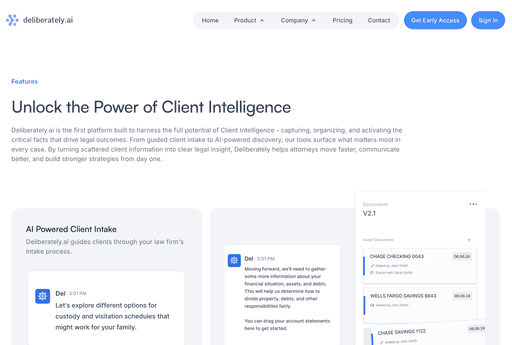
One of the earliest points of change is client intake. Traditional intake processes depend on clients to understand what information is required and how to provide it. In practice, this often leads to gaps, inconsistencies and multiple rounds of follow-up.
More structured approaches are beginning to emerge. Instead of static forms, some systems guide clients through the process in a more adaptive way, identifying missing or unclear information as it is entered.
The result is not simply convenience. Cases begin with more complete and more reliable information, which reduces downstream friction and allows attorneys to engage with the substance of a matter earlier.
From Documents to Structured Facts
Family law generates a large volume of documents, including bank statements, tax returns, disclosures and court filings. Historically, reviewing these materials has been a manual process. Information is read, interpreted and then re-entered in a usable format.
What is changing is not the existence of these documents, but how they are used.
Information that was once embedded in files is increasingly being extracted and structured. Income figures, account balances and transaction histories can be organized in a way that makes them easier to access and analyze.
This does not replace the role of the attorney. It changes where attention is directed. Less time is spent locating information. More time is spent interpreting it.
Try now for free the Child Support Calculator from Deliberately.ai
Seeing the Full Picture
Another persistent challenge in family law is developing a clear view of the entire case. Relevant information is often distributed across documents, messages and prior filings. Reconstructing that context requires time and sustained attention.
When information is organized in a more structured way, connections become easier to see. Timelines are clearer. Financial relationships are easier to understand. Missing information is more readily identified.
This shift is subtle but important. Work becomes less reactive and more deliberate. Attorneys are not simply responding to incoming information. They are working from a clearer understanding of what is already known.
Reducing Repetition
Much of family law practice involves repetition. The same client and financial information must be reflected across multiple documents, including disclosures, motions and summaries.
When information is structured at the outset, it can be reused more consistently. This reduces manual entry, improves accuracy and shortens the time required to produce routine documents.
The benefit is not only efficiency. It is also consistency. When the same information flows through a case without repeated re-entry, the risk of small but consequential errors is reduced.
Supporting Financial Analysis
Deliberately AI is more than just a lawyer AI tool—it’s reshaping the way law firms and clients manage information across family law, immigration, estate planning, personal injury, employment law, and beyond.

Financial analysis is central to many family law matters. Determining support obligations, evaluating income and dividing assets all depend on accurate and complete data.
More structured approaches to information allow attorneys to work from consolidated financial views rather than assembling figures from multiple sources. This can make analysis more straightforward and reduce the likelihood of oversight.
Judgment remains essential. The role of the attorney is not diminished. It is supported by clearer information.
Improving the Client Experience
Family law clients often operate under significant stress. Uncertainty about what to provide, what happens next and how long the process will take can add to that burden.
When information is collected and organized more effectively, communication becomes more predictable. Clients receive clearer guidance. Fewer follow-up requests are required. Expectations are easier to manage.
In a field where emotions run high, clarity has practical value.
A Shift in How Work Is Organized
It is useful to think of these changes not as a collection of tools, but as a shift in how information is handled across a matter.
In many traditional workflows, documents are stored and revisited as needed. Understanding a case requires repeatedly reconstructing context from those materials.
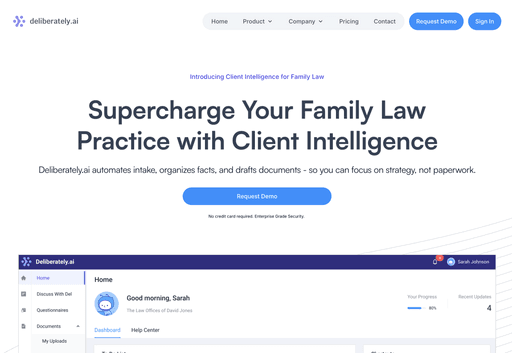
Discover how Deliberately AI is redefining the way Family law firms and attorneys work.

A different model is beginning to take shape. Information is captured, structured and connected from the beginning. Facts are easier to retrieve. Relationships between pieces of information are more visible. The current state of a case is easier to understand at any given moment.
This distinction, between managing documents and organizing facts, is where much of the long-term impact will emerge.
What This Means Going Forward
AI is not replacing family law attorneys. It is reducing the amount of time spent assembling and organizing information so that more time can be spent exercising judgment.
Firms that adopt more structured approaches to information tend to become more consistent in their work and more deliberate in how they allocate time. As caseloads grow and expectations accelerate, this shift becomes increasingly important.
The question is not simply how AI is used in family law. It is how the underlying structure of legal work is evolving.
Final Thought
Family law has always required careful judgment applied to complex and often emotional situations. That has not changed.
What is changing is how quickly attorneys can access the information they need to make those judgments.
When information is easier to gather, organize and understand, the work itself becomes more focused. And in family law, the ability to deliver clear, well-considered guidance at the right moment remains one of the most valuable services an attorney can provide.
Related Articles
Posted by
on
Posted by
on
Posted by
on