
What Is AI for Family Law?
Artificial intelligence for family law refers to software systems trained to understand, organize, and act on the specific information that drives family law cases — financial disclosures, parenting schedules, asset inventories, income documentation, and court filing requirements.
Unlike general legal AI tools, which typically assist with research and drafting across all practice areas, family law AI is purpose-built for the operational reality of divorce, custody, support, and property division cases. It understands what an FL-150 is, how to calculate the income shares model for child support, and what a parenting plan needs to include under state guidelines.
According to the American Bar Association’s Legal Technology Resources (americanbar.org/groups/legal_technology_resources), AI adoption in law firms has accelerated significantly since 2023, with family law cited as one of the practice areas where automation delivers the highest operational return — precisely because the workflows are structured, repetitive, and data-intensive.
KEY DISTINCTION General AI (like ChatGPT) can write text. Family law AI understands the context in which that text must be written — the jurisdiction, the form type, the case facts, and the compliance requirements. That difference is everything in legal practice. |
What Deliberately.ai Can Do in a Family Law Firm — Right Now
The honest answer is: more than most attorneys currently realize. Here is a grounded breakdown of what is production-ready in 2026:

1. Intelligent client intake and onboarding
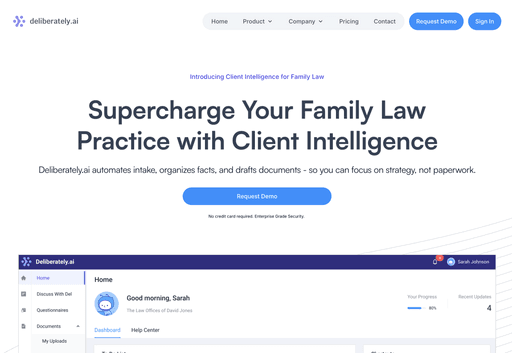
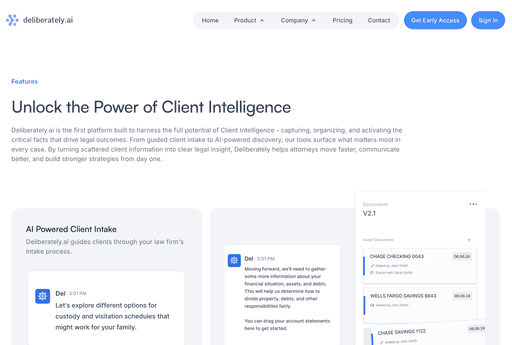
Traditional client intake involves emailing questionnaires, chasing missing documents, and manually entering information into case management systems. AI-powered intake replaces this with a dynamic, conversational process where the client is guided through uploading documents, answering structured questions, and completing financial disclosures — all without attorney involvement.
The system reads what is submitted, identifies what is missing, and follows up automatically. By the time the attorney opens the file, the client’s information is already organized and summarized.
2. Document ingestion and fact extraction
Family law cases generate enormous volumes of documentation — bank statements, tax returns, W-2s, property deeds, credit card statements, text message screenshots, pension valuations, and more. AI can read all of these, extract the relevant financial facts, and organize them by category in seconds rather than hours.
Modern platforms like Deliberately.ai can process even unstructured inputs: photos of handwritten notes, scanned documents, and screenshots of text conversations.
3. Child and spousal support calculations
Support calculations require applying jurisdiction-specific income shares or percentage-of-income models to the parties’ actual financial data. AI can now perform these calculations automatically from the client’s financial data, with real-time scenario modeling (“what if income changes?”, “what if parenting time shifts?”).
Test our Child Support Calculator for Free
4. Court document drafting and form population
Completing forms like income and expense declarations, financial disclosures, and parenting plans involves populating dozens of fields from data already collected during intake. AI can auto-populate these forms, attach source documents, and flag any fields that require attorney judgment.
5. Case summaries and attorney briefings
Before a client call or court hearing, AI can generate a current case summary on demand — pulling together the latest documents, outstanding items, and key facts from the entire case file — in plain language, in seconds.
73% of a family law paralegal’s time is spent on tasks AI can now fully or partially automate Source: ILTA Legal Technology Survey (iltanet.org/research) |
What AI Still Cannot Do (And Never Should)
Any vendor that tells you AI can replace attorney judgment is either misinformed or selling something. Here is what remains firmly in the human domain:
Legal advice and strategic counsel. The decision to settle versus litigate, how to approach a difficult opposing counsel, how to frame the client’s narrative for a judge — these require the judgment that comes from years of practice.
Client relationship and emotional intelligence. Family law clients are in crisis. The empathy and human connection attorneys provide cannot be replicated by software.
Courtroom advocacy. Cross-examination, oral argument, and the dynamic reading of a courtroom require human presence and real-time judgment.
Complex legal interpretation. When a statute is ambiguous or case law conflicts, human legal analysis and creative thinking are irreplaceable.
THE RIGHT MENTAL MODEL Think of AI as handling the information layer of your practice — collecting, organizing, calculating, drafting, and tracking. This frees attorneys to focus entirely on the judgment layer — strategy, negotiation, advocacy, and client counsel. |
5 Real Use Cases: AI in Family Law Practice
Use case 1: The solo practitioner who runs without support staff
A solo family law attorney in Portland manages 35 active cases. Before using AI, she employed one paralegal and still felt behind. After implementing Deliberately.ai, intake became fully automated, case summaries were generated on demand, and support calculations took seconds. She now runs 40 active cases with no support staff — and reports higher client satisfaction.
Use case 2: The mid-size firm reducing paralegal administrative burden
A five-attorney firm was spending an estimated 30 hours per week on document collection, filing, and intake follow-ups. After deploying AI-powered intake and document management, those 30 hours were recovered — paralegals shifted to higher-value work, and the firm handled 20% more cases without adding headcount.
Use case 3: The high-asset divorce with complex financial disclosures
When a client arrives with hundreds of pages of financial documents, AI platforms can process the entire set, extract every relevant financial figure, categorize it correctly (community vs. separate property), and surface any discrepancies between documents — automatically.
Use case 4: Multi-state child support modification
When a client’s support order needs modification, AI can pull the relevant guideline worksheet, apply the client’s current income figures, and produce a modification calculation with sources attached — in minutes.
Use case 5: Client-facing case transparency
AI platforms now offer client-facing portals where clients see their case status, outstanding document requests, and upcoming deadlines in real time — reducing the “what’s happening with my case?” calls that consume attorney and staff time.
Ethics, Bar Compliance, and Data Security

Confidentiality (Model Rule 1.6)
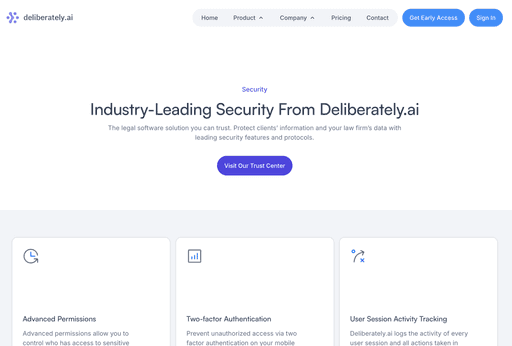
Client information fed into an AI system must be handled with the same confidentiality protections as any other attorney-client communication. This means using platforms with end-to-end encryption, role-based access controls, and audit trails — not general consumer AI tools where data may be used for model training or stored insecurely.
Competence (Model Rule 1.1)
The ABA’s Comment 8 to Rule 1.1 explicitly identifies keeping abreast of changes in the law including the benefits and risks of relevant technology as part of competence. An increasing number of state bar ethics opinions now say that an attorney who fails to understand available AI tools may not be meeting the competence standard.
Supervision of AI output
AI-generated documents, calculations, and summaries must be reviewed and approved by a licensed attorney before being filed or presented to clients. The attorney remains responsible for the output. Purpose-built legal AI platforms are designed with this in mind — they generate drafts, surface sources, and flag uncertainty.
DATA SECURITY STANDARD TO REQUIRE When evaluating any AI platform, require: end-to-end encryption at rest and in transit, SOC 2 Type II compliance or equivalent, role-based access controls, complete audit trails, and a data processing agreement confirming client data is never used for AI training. |
How to Choose AI Software for Your Family Law Firm
Not all legal AI is created equal — and most of it was not built for family law. Here is the evaluation framework:
Criterion | What to look for | |
Family law specificity | Built for family law, not adapted from a general tool? | ✓ Built exclusively for family law |
Client intake automation | Can it guide clients through document upload and disclosures? | ✓ AI-guided intake engine |
Support calculations | Child and spousal support by jurisdiction? | ✓ All 50 states |
Document analysis | Extract facts from PDFs, scans, and images? | ✓ OCR + unstructured data parsing |
Court form drafting | Auto-populates jurisdiction-specific forms? | ✓ FL-150, disclosures, parenting plans |
Data security | Enterprise encryption, audit trails, role-based access? | ✓ SOC 2–level protocols |
Client portal | Clients can access status and upload securely? | ✓ Dedicated portal included |
See Client Intelligence in action Watch a 5-minute demo of how Deliberately.ai transforms family law intake, document management, and court prep. → deliberately.ai/request-demo No credit card required · Setup in under a day |
Frequently Asked Questions
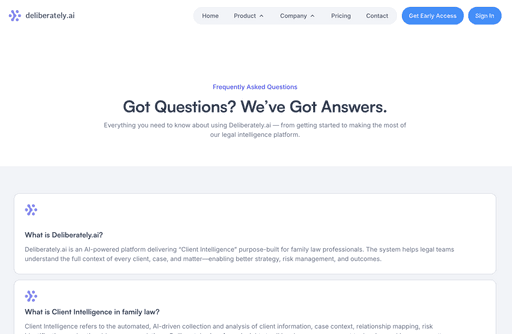
Q: What is AI for family law?
AI for family law refers to software systems that use artificial intelligence to automate and enhance the tasks family law attorneys perform daily — including client intake, document review, child and spousal support calculations, case analysis, and court document drafting. Unlike general legal AI tools, purpose-built family law AI understands the specific data structures, forms, and workflows of divorce, custody, and support cases.
Q: Can AI replace a family law attorney?
No. AI cannot replace the judgment, empathy, and strategic thinking of a qualified family law attorney. What AI can do is handle administrative and analytical tasks — document collection, data organization, support calculations, and form drafting — so attorneys can focus on work requiring human expertise: negotiation, client counseling, courtroom advocacy, and complex legal strategy.
Q: What tasks can AI handle in a family law firm?
AI can handle: client intake and onboarding, document collection and organization, extraction of key facts from uploaded files (including scans, photos, and PDFs), child and spousal support calculations across all 50 states, drafting of standard court forms and financial disclosures, automated case summary generation, deadline and task tracking, and client portal communication.
Q: Is AI-generated legal work ethically permissible?
Most state bar associations now permit attorneys to use AI tools in legal practice, provided the attorney reviews and takes professional responsibility for the output. The ABA’s guidance on competence (Model Rule 1.1, Comment 8) increasingly includes understanding AI tools as part of technological competence. Attorneys must ensure AI-generated content is accurate and compliant before filing or presenting it.
Q: How does Deliberately.ai differ from general AI tools like ChatGPT?
ChatGPT is a text generator without legal-grade security, without integration into case management workflows, and without jurisdiction-specific court form or support calculation knowledge. It cannot securely process client financial documents, has no audit trail, and inputting client data into a consumer AI product likely violates attorney confidentiality obligations. Deliberately.ai is purpose-built for family law with SOC 2–level security, court document system integration, and AI trained specifically on family law workflows.
ABOUT THE REVIEWER Hans Guntren Deliberately.ai · CO-Founder Hans is a seasoned technology leader and AI entrepreneur with over 20 years of experience in enterprise product design and innovation. As Co-Founder and CEO of Deliberately.ai, he drives AI-powered transformation in legal tech. His background includes leadership roles at C3 AI and IBM, shaping scalable, high-impact products. |
Related Articles
Posted by
on
Posted by
on
Posted by
on