
The idea behind the 80/20 rule is straightforward: a small portion of effort should drive the majority of results. In a profession where time is the primary constraint, the principle is intuitively appealing.
In practice, however, most family law firms operate far from this ideal.
Attorneys do not spend most of their time on strategy, negotiation or advocacy. Instead, much of the workday is consumed by incomplete intake, document follow-ups and the ongoing effort of assembling a coherent understanding of each case from scattered information.
The issue is not a lack of awareness. Most practitioners understand where their highest-value work lies. The difficulty is structural. The way information enters and moves through a case makes it difficult to prioritize that work consistently.
The Constraint Is Not Time
Discussions about efficiency in law firms often focus on time management. But time is not the underlying constraint. The more fundamental issue is how information is collected, organized and used.
At the outset of many family law matters, information arrives in fragments. Clients provide partial details. Financial documents are submitted over time. Key facts are distributed across emails, attachments and notes. Before any meaningful analysis can begin, someone must assemble these pieces into a usable form.
This work is necessary, but it is also labor-intensive. By the time the attorney is ready to engage with the substance of the case, a significant portion of effort has already been spent establishing basic context.
Under these conditions, the 80/20 rule becomes difficult to apply. When the foundation of a case is disorganized, attention cannot simply be redirected to higher-value tasks. The initial effort must go toward making sense of the inputs.
Why Existing Systems Fall Short
Most firms already rely on a range of tools, including case management systems, document storage platforms and intake forms. These systems are essential, but they are primarily designed to store information rather than interpret it.
As a result, the responsibility for turning raw inputs into usable understanding remains with the legal team. Information is collected, cleaned, organized and then interpreted, often across multiple systems.
This workflow introduces friction at each stage. Time is spent not only on legal reasoning, but on preparing the information required to support it. As caseloads increase, this model becomes increasingly difficult to sustain.
A Shift In How Information Is Handled
What is beginning to change is not simply the speed of individual tasks, but the structure of the workflow itself.
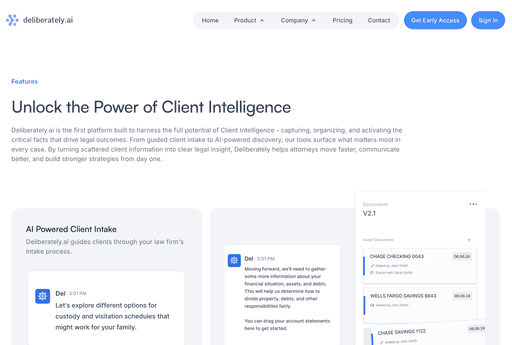
In more structured approaches, information is captured in a way that reduces the need for later reconstruction. Client intake becomes more complete and consistent. Documents are not only stored, but organized so that relevant details are easier to access.
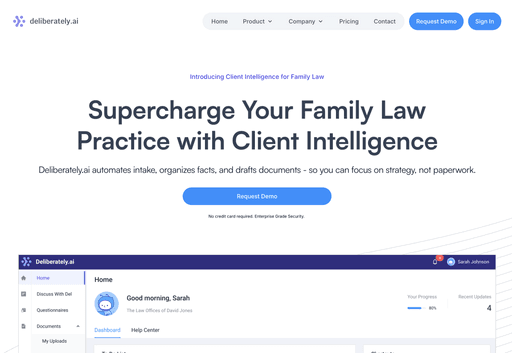
Watch the video below and understand how Deliberately AI Transforms Legal Practice.
The effect is cumulative. When information is structured early, it can be reused across the life of a matter without repeated manual effort. The time previously spent assembling context is reduced, allowing attorneys to engage with analysis sooner.
This is less about automation in the narrow sense and more about shifting from systems that store information to systems that make it usable.
From Reconstruction To Understanding
One of the most noticeable changes in this model is how quickly a case becomes clear.
In traditional workflows, understanding develops gradually as information is gathered and organized. Attorneys often move back and forth between documents, notes and communications to build a complete picture.
When information is more structured, that picture is easier to see earlier. Key facts are accessible. Relationships between pieces of information are more apparent. Gaps can be identified more quickly.
This changes how time is spent. Less effort goes toward reconstruction. More effort goes toward interpretation and decision-making.
Reconsidering The 80/20 Principle
Under these conditions, the 80/20 rule becomes more applicable.
When the underlying structure of information is more reliable, attorneys can spend a greater share of their time on work that requires judgment. Strategy, advocacy and client guidance become more central to the daily workflow.
This does not remove the need for administrative work, but it reduces the proportion of time devoted to it. The role of the attorney shifts from organizing information to applying expertise.
Implications For Practice Growth
There are also practical implications for how firms grow.
In workflows that rely heavily on manual organization, scaling often requires adding staff. While this can increase capacity, it also introduces additional complexity and cost. Over time, this approach can limit flexibility.
When information is handled more systematically, growth can occur without a proportional increase in administrative burden. Cases move more consistently. Errors are reduced. Teams spend less time on repetitive tasks and more time on substantive work.
This does not eliminate the need for investment in people. It changes how their time is used.
Family Law AI Software Demo

The Client Experience
Clients experience these changes in more subtle ways.
When information is collected and organized more effectively, communication becomes clearer. Clients are less likely to be asked for the same information multiple times. Expectations are easier to set. Progress is more visible.
In family law, where uncertainty can be a significant source of stress, this kind of clarity has meaningful value.
Rethinking The Underlying System
For many years, law firms have treated administrative work as an unavoidable part of practice. A significant portion of time has been expected to go toward gathering and organizing information before legal analysis can begin.
That assumption is beginning to shift.
Rather than focusing solely on managing workload more efficiently, some firms are reexamining the structure that creates the workload in the first place. When information is captured, organized and surfaced more effectively, a portion of that work can be reduced or avoided.
Final Thought
The 80/20 rule was never inherently incompatible with legal practice. It was constrained by the way legal work has traditionally been organized.
When the flow of information improves, the distribution of effort begins to change. More time becomes available for the work that requires judgment, and less is consumed by the effort required to reach that point.
In family law, where outcomes often depend on clarity, timing and decision-making, that shift can be significant.
Related Articles
Posted by
on
Posted by
on
Posted by
on